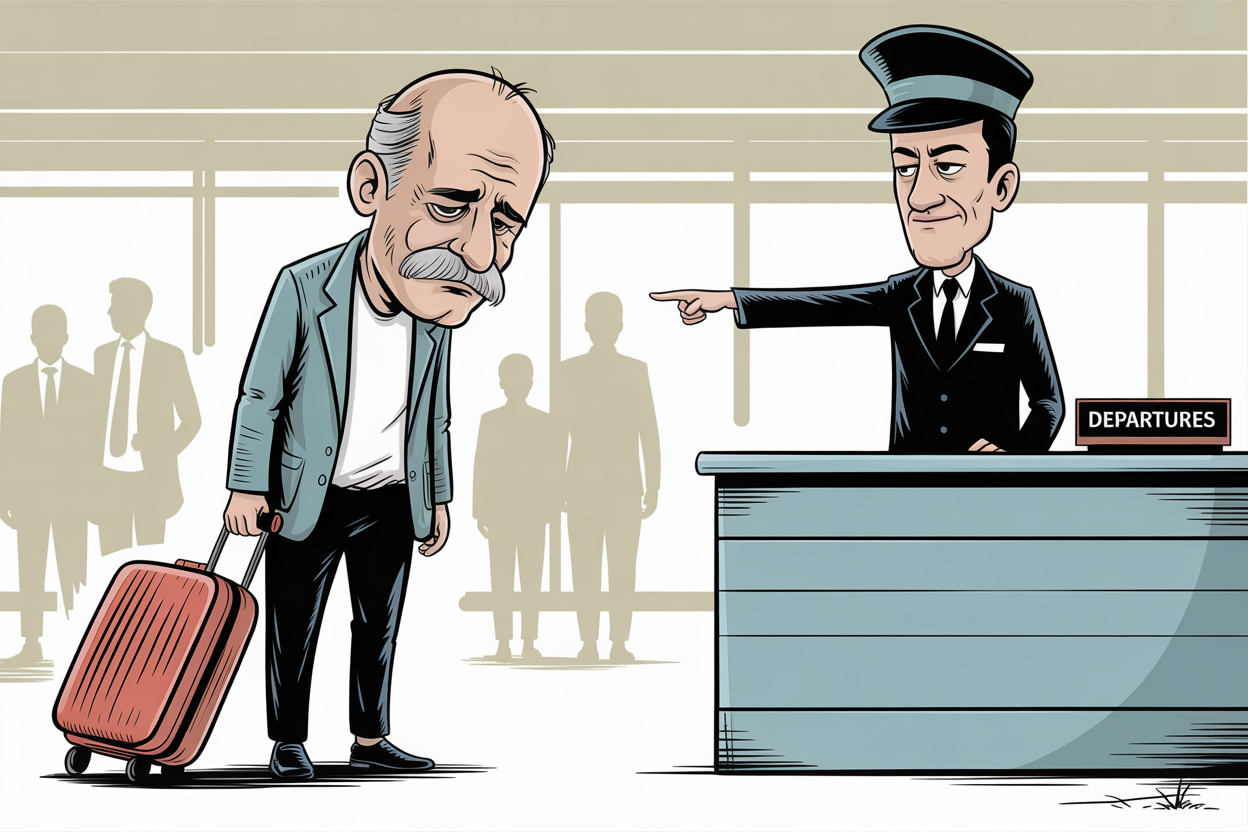
Last spring, my family had tickets to fly from Fort Myers, Fla., to Milwaukee, Wis. When we arrived at the gate, a Southwest agent told us our flight was oversold and that all seats had been assigned. We were denied boarding.
[continue]

Last spring, my family had tickets to fly from Fort Myers, Fla., to Milwaukee, Wis. When we arrived at the gate, a Southwest agent told us our flight was oversold and that all seats had been assigned. We were denied boarding.
[continue]
Question: We recently canceled a trip from Minneapolis to Asuncion, Paraguay, that we had booked on Delta Air Lines through Expedia. We were issued two flight vouchers, which we are trying to redeem. But Expedia isn’t letting us.
The vouchers — one for $1,186, the other for $936 — were supposed to be valid until Jan. 15. But when I called Delta to cash them in, we were told the vouchers had already expired in September.
[continue]
When Cecilia Tanaka tried to buy tickets to Japan on Expedia, she was charged twice. She filed a dispute with her credit card, thinking it was a simple misunderstanding.
It wasn’t. Neither her online agency nor her airline, ANA, saw the transaction like she did, setting her off on a long odyssey to fix the mistake. Her story offers an important lesson or two for all of us who book airline tickets online.
[continue]
Barney Harford is the president and chief executive officer of Orbitz Worldwide. One of the first things he did when he took over eight months ago was to institute a “total” price for hotel rooms, making it the first of the major online travel agencies to do so. He also launched a campaign to lift travel restrictions to Cuba imposed by the American government during the Cold War. I asked Harford why he decided to take on prices and politics so early in his tenure.
Your company is pushing the government to lift travel restrictions to Cuba with a new site called Open Cuba. Why is this issue important to you? Why should it be important to travelers?
We believe it’s important to be engaged in the social issues of the day. We promoted lesbian and gay travel as far back as 2002. We were on the cutting edge of eco-tourism.
The management team and I shared a belief that after 50 years of ban on travel to Cuba [by Americans] it was time for a change. It doesn’t make sense for Americans to not have a right to travel to a country that is so close. Travel can bring people together. We believe there’s an immense opportunity to bring people together, to create progress.
We have urged people to sign a petition to overturn the ban on travel to Cuba. We’ve had about 95,000 people sign it. There’s broad, grassroots support that’s been indicated on this issues. We hope to be able to play an important role in removing the ban.
[continue]
Question: I recently bought tickets to Italy by calling Expedia. I spelled my wife’s first name to the agent. That afternoon we left town for a trip. When we returned the tickets were at the front door and a confirmation e-mail was waiting. My wife’s first name was spelled Crista instead of Christa.
I immediately called Expedia, and was told I should have contacted them the day the e-mail was sent to me and that there would be a $150 re-ticketing fee. After several more calls and being put on “hold” for more than half an hour, a supervisor told me that there was nothing they could do. They couldn’t even change the name on the ticket.
I contacted the airline directly and they told me they would make a note on my wife’s passenger record. My wife’s tickets are still wrong and I’m afraid we may have a problem with our connecting airline or with customs. What can I do? — Frank Santa Maria, New Braunfels, Texas
Answer: Expedia should have spelled your wife’s name correctly. When it was clear that the company had made an error, it should have done everything in its power to fix it instead of giving you the runaround and forcing you to deal directly with your airline.
Then again, it should have never come to this. First, why are you phoning an online travel agency to buy tickets? It may be more convenient, but online agencies are built to handle your purchases online. It’s more efficient and reduces the chance of an error being introduced — like misspelling a passenger’s name.
Second, you should always check your verification e-mail immediately. Expedia could have made a change to your ticket if you had caught the mistake earlier. It’s essential that you review your itinerary as soon as possible. Believe me, I know. I just made this mistake and had to spend an extra day at my destination because I put the wrong date in my reservation. (See? It can happen to anyone.)
I’ve dealt with too many wrong-name cases to count, and here are a few things I’ve learned. Passengers aren’t turned away at the gate because of a typographical error on their tickets. Reservations systems have limitations that sometimes truncate last names or render non-English names in funny characters. Last names and first names are frequently flip-flopped. Ticket agents, gate agents and security screeners know that, and will let you through.
I haven’t heard of anyone being denied boarding because of a one-character difference in a name. I’m reasonably sure your wife would have been allowed to travel using her ticket, even if this had happened after the May 15 implementation of the first phase of the Transportation Security Administration’s “Secure Flight” initiative, which requires that you provide your full name as it appears on your government-issued identification.
Incidentally, the “notation” in her reservation would have almost certainly been visible to any connecting airline. And a customs agent wouldn’t even pay attention to your ticket under normal circumstances. It’s your customs form and passport that matter to them.
Next time you buy tickets by phone — and I hope there’s no next time — do yourself a big favor: When you offer your name to the agent, ask to have it spelled back. That way, you’ll catch any errors before the transaction goes through. Once you have a reservation, it becomes much more difficult (or even impossible) to make a change.
It shouldn’t be that way. In an ideal world, you’d be able to change a name on a ticket. Airlines say they can’t allow name changes for “security reasons” but I’m inclined to believe it has more to do with the fact that they would lose lots of money if passengers could give their tickets to friends and family. Or resell them.
I contacted Expedia on your behalf, and it issued a new ticket with your wife’s name spelled correctly.
The roundtrip airfare from Madison, Wis., to London is a reasonable $305 on American Airlines — until you add taxes, fees and fuel surcharges. Then it’s $691.
Delta Air Lines charges $742. Wait, make that $942 after you add in all the mandatory extras. And Lufthansa? $580. I mean, $1,034.
When Gregory Dyslin, a computer specialist who lives in Madison, found these prices through Orbitz, he was flabbergasted. “How in the name of all that is holy and right can they say this?” he wondered.
Airlines break out their fares in this increasingly absurd way because it makes their prices look lower — at least, at first — and because they’re allowed to. As long as a total fare is quoted at the end of the transaction, the government doesn’t get in the way.
Agencies like Orbitz are caught in the middle of this bizarre pricing game, in a way. But in a way, they also play along. The results of Orbitz’ search, which are displayed as a matrix, yield two fares: a less expensive base fare on top that’s boldfaced, and a “total” fare that appears below it in normal type. Why not just show the full fare?
“We want consumers to know exactly what they’re paying for,” says Orbitz spokesman Brian Hoyt.
What’s so wrong with quoting a pre-tax price? Don’t other businesses do that, and aren’t consumers used to running a few numbers before they buy? Yeah, but how much mental math should be required? It’s one thing to add a 7 percent sales tax, and quite another to more than double the price of the ticket.
Mandatory fees have ballooned in recent months, largely because of fuel surcharges. Never mind the fact that oil prices are well off their record highs. Meanwhile, base fares remain low, presumably to entice more people to fly. If they keep this up, we’ll all be buying zero dollar fares, like they did on Ryanair a few years ago. (Technically, those were zero pound fares, but you get the idea.)
Maybe that’s one reason why Europe recently enacted a tough new price transparency law, which requires airlines to quote a fare including all taxes, fees and surcharges.
If only that solved the whole problem. There’s also a third layer of fees that don’t have to be disclosed, such as charges for the first checked bag and drinks. Airlines may consider these optional, but who goes on vacation without luggage? And who spends a few hours on a plane without asking for a cup of water?
The airline industry believes these fees have no place in a price quote. Victoria Day, a spokeswoman for the Air Transport Association, described baggage and beverage fees as “separate transactions” that should not be included in the initial fare quote. I asked Day if the industry had any plans to voluntarily disclose those fees at the point of purchase, as part of the total fare. She deferred to the individual airlines, saying advertising and pricing policies were up their members.
But there are signs the Transportation Department, which regulates how fares are advertised, may see things slightly differently. Last year, for example, it forced Delta to refund baggage fees the airline had collected on tickets bought before it announced it would start charging for the first checked bag, signaling that air carriers couldn’t do as they pleased when it came to fees. Passenger rights activists think that at a time when regulation is viewed more favorably in Washington, a price transparency rule in the European model might fly.
Until that happens, here are a few tips for seeing your way around these surprise fees.
Pay attention
For now, the government requires that the final price of the ticket — minus “optional” items like luggage fees — be disclosed before you buy. Be sure you’re clicking the “buy” button next to the price you expected to pay. For example, when I checked Delta’s Web site for flights from Orlando to Dallas recently, I was shown a fare “From $269” in large boldface type followed by “+$42.40 taxes/fees = $311.40 in small print. Oddly, clicking on the fees took me to a page that said, “We don’t want you to have any unpleasant surprises on your bill. We’re making every effort to let you know about any taxes and fees that might be included.” Every effort? So why advertise a lower base fare so prominently, and not a total fare?
Buy from a trusted source
A few years ago, I saw a terrific airfare advertised at a mom-and-pop travel agency down the street. I walked into the store and asked an agent if any tickets were still available at that price. “Yes,” the agent said, and then whipped out a calculator. “But the fare is wrong.” She then added what appeared to be a commission to the price of the ticket and quoted a new, higher price. It was surreal. I thanked her and walked out without telling her what I did for a living. Needless to say, I now buy my tickets from a trusted source — either a travel agency I know or directly from an airline. Changing the price of a ticket after you’ve decided to book is a no-no, and any travel company that does it is ethically challenged.
Keep abreast of the rule changes
Last year may have been a doozie for new airline fees, but there’s more to come. Already, the fee geniuses at Ryanair have announced they will begin fining customers who bring too much carry-on luggage onboard. What’s next? No one knows, but it’s now up to all of us to keep up with these surcharges so that we don’t have to pay a £30 fine for bringing our laptop computer on the plane.
Question the fare after you book
You probably already know about Web sites like Yapta which track fare changes and help you secure a refund when your airfare falls. But you should also track other elements of your fare, such as fuel surcharges. Simon Gornick did after Virgin Atlantic eliminated a $400 fuel surcharge on his ticket from Los Angeles to London recently. He asked Virgin for a refund — and it refused — but the answer isn’t always likely to be “no.” If an airline is paying less for fuel, shouldn’t it pass the savings along to you?
Run your own numbers
Airline pricing systems are far from perfect. That’s what Eric Hochstein, an economic consultant from Barrington, Ill., discovered when he bought tickets from Chicago to Miami recently. Later that day, the fare dropped by $15, but a closer look at the fare breakdown revealed that the taxes appeared to account for most of the reduction. “What’s going on?” he asked. Hochstein is still waiting for an explanation from American. In the meantime, it goes without saying that you shouldn’t accept your airline’s fare breakdown as Gospel truth.
Petition the government
The folks at the online travel agency Lessno.com, who were one of the forces behind the new European fare transparency rules, have launched a petition drive that’s meant persuade Congress that the current fare display rules are ineffective. “For too long, airlines, travel agents, and airfare resellers have gone without oversight from governmental authorities that has enabled them to abuse and mislead American travelers,” they say. (You can read the petition here.) Whether you agree that airfares are screwed up, or you think I am, it never hurts to let your elected representatives in Washington know how you feel. It’s easy.
Don’t let the airlines pull a fast one the next time you fly. Buy your tickets from someone you trust, follow the fees, ask hard questions, and above all, look before you book.
The current fare displays are either misleading or totally dishonest. You deserve better. We all do.