How to survive a tsunami in your hotel

No one expects to get whacked by a tsunami on their vacation. I certainly didn’t when I checked into the Grand Wailea Resort in Maui on Wednesday night.

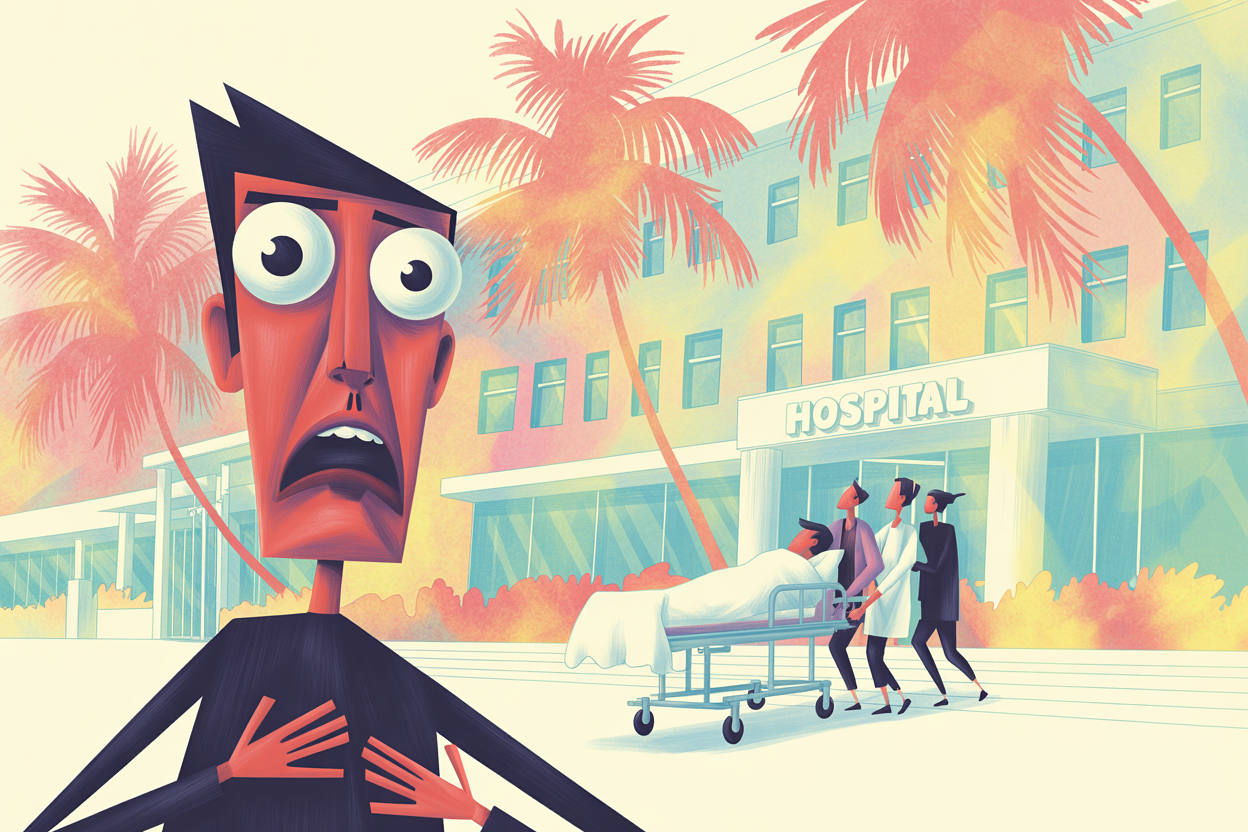
But on Thursday evening, the sirens started blaring, warning that a killer wave could be headed our way.

I don’t mean to downplay the tragedy of what happened in Japan, where the earthquake struck. What they experienced is so much worse than the inconvenience of having to get out of bed a little early.

Our thoughts and prayers are with the victims in Japan, of course.

But there’s a right way and a wrong way to get through a tsunami warning in a hotel. I’m a textbook case of the wrong way.

First, I didn’t even know what to listen for. I wish I’d taken a few seconds to educate myself. Here’s what a typical tsunami siren sounds like, in case you were wondering. Ours was just a little different, but similar enough.

I slept through mine. A phone call from a friend alerted me to the evacuation.

Second, take only your valuables and medication. Too many guests ignored repeated requests by the hotel to bring only what’s necessary, and as a result, the lobby was cluttered with people’s luggage. So now, in addition to a tsunami warning, we had a fire hazard.

Also, follow the staff’s directions, when it comes to safe zones. A few guests decided to get a closer look at the water just as the first wave was about to strike.

C’mon.

Security had to run down to the beach to retrieve these Darwin Award finalists.

Of course, where you stay matters. I was lucky enough to have a room at a nice resort in Maui.

They do tsunamis in style.

Guests were served steaming hot coffee – the good kind, not the instant stuff they give you in the rooms – fruit and pastries. (Hey, if you’re gonna get swept away by an enormous wave, you might as well do it with a decent cuppa joe.)

The staff was right on top of things. I think they called everyone back to work last night to take care of the displaced guests. We were among the customers who had to be moved; our room was on the ground floor, right within striking distance of the ocean.

My best advice is that if you’re staying anywhere near the ocean, be aware of tsunamis and know which precautions to take, follow all the instructions (even the ones you don’t want to) and consider yourself lucky if you survive.

We got the “all clear” at 6:30 a.m.

  • http://www.ksqrd.com Kate Koziol

    Stay safe Chris! Great advice for all travelers. Maybe you need a series on “when good things go bad” as it relates to travelers – a premptive emergency information kit.

  • cjr

    My wife lived in Kailua-Kona, Big Island for a number of years, so whenever the warnings occur, we keep a close eye on things, as she still has family and friends there.

    And, from the sound of things, Kona may have received the biggest waves as the tsunami propagates around the islands. Unlike Waikiki, which has a beach separating most of the hotels from the waterfront, Kona is right along the water with no beach.

    So, Christopher, it’s good to hear that you had no real problems, and that you’ve learned something from this. But those Darwin Award finalists? They’ll never learn, and the locals are just as bad as the tourists.

  • Carrie Charney

    Chris, please explain why you were all evacuated to the lobby of the hotel. Isn’t that on low ground, or is it on a higher floor like at the Marriott Marquis in NYC?

  • Tom

    Hope you are pitching this story to the Washington Post — it’s more than blog material. How did Iden take all the fuss?

  • bodega

    Something to consider in Hawaii, is that your rental car isn’t covered by water damage with many insurance policies, so getting it to higher ground if safe to do so, is important, too.

    I think CA is getting it worst than the islands, and since all stations are covering local beach areas, not much has been said about Hawaii.

  • laura

    Chris- my agency is responding to the tsunami in Japan, so we’ll know more in a bit.

    Glad your experience is a little more comfortable.The Grand Wailea is a great place to weather any storm.

  • Christopher Elliott

    @Carrie, the lobby is on the fourth floor.

  • Roberto Pascal

    I’m planning a trip later this year, is there extensive damage to the resort?

  • Christopher Elliott

    @Roberto, no damage as far as I can see.

  • Matilda

    Glad to hear everyone is safe and that your hotel seems to be on top of things.

  • DJP

    I live in the Seattle area

    The Seattle area can be affected by Tsunamis as well as inland water areas like the San Fran bay area and a major river inlet areas like the Columbia River.

    All the coastal towns have Tsunami warning sirens that went off.

    The severity of the Tsunami will depend greatly on the topography of the coastline as was seen in Thailand where you have resort town that was hit hard while a neighboring coastal town got minor damage.

    Another factor in play is your elevation above sea level. For example a place that was affected was Cannon Beach, OR (home of haystack rock). If you ever been there you would know that not all the town had to be evacuated because there are portions of the town that are 100+ feet above sealevel along cliffs so this Tsunami wasnt going to do anything to them.

    A good portion of the washington and Oregon coasts are cliffside beaches so a Tsunami wont penetrate. There are places like Eureka that is flat coast land that could have a bigger impact inland.

    With the Tsunami warning what cities do not want are people evacuiating who do not need to.

    Also if you are in a hotel in Maui…its safer to actually go up to higher floors in the hotel or the roof than to meet on the ground floor. A 7 foot Tsunami on the coast without other debris will not take down a 5-10 story hotel…it will flood and damage the first and second floors.

    The problem is from the forecasting perspective is that its hard to predict the height of the Tsunami a distance away because its based on the very local terrain of the coastline.

    You can have the same magnitude earth quake in the same location…one generated a local tsunami that doesnt affect any other place a few hrs away because it quickly tapers off—then another happens at the same spot and same magnitude but this one does generate the same Tsunami locally but it is carried a much farther distance away.

    Why–one big factor is what kind of fault it is and what motion occurred between the rocks. The 2004 Indian Ocean Tsunami was generated because rock shifted upward and downward during the quake. You could have the same magnitude quake that is more of a sliding slip fault where the rocks run parallel (San Andreas fault in California is more like the latter kind of fault movement) to each other with no upward or downward moving of rock.

  • LadySiren

    Chris, glad to hear you’re all safe. My family and friends have checked in and all is well. Now if only my family in OR didn’t have to worry about evacuating…

  • Thomas

    Hey Chris, Were you scared when you saw the 3′ wave? :)

    I’m on my way to Japan in 3 hours. Will let you know what I find.

  • Melissa

    Thanks Chris, glad to hear you are OK. If any of the “the rules don’t apply to me” fools are reading this, please listen closely…risk your own life if you must, but for the love of God, don’t take the rest of us down with you. No one needs to see what a Tsunamis looks like up close, and if you are so selfish to believe you are entitled to see it, then realize now you are making security risk their lives to come after you. Also, if the hotel says only grab your medication and valuables, again, who are you that you should bring all your belongings? Tell me, what will you do with your cute little wedge sandals when you are getting knocked down by a wave? All they will do is either fly off and hurt someone, (unfortunately that someone probably won’t be you), or like Chris said, they will trip people up in the event of a fire. You are probably the same person who parks in front of the convenience store, even though it says no parking…because it’s “just for a minute”, and the rules “don’t apply to you”.

  • Tim

    Glad to hear you’re ok. Shocked to hear you’re staying at one of the most egregious nickel-and-diming hotels in the country. $25 resort fee, mandatory $20 valet parking, $350/day for a cabana….

  • Carrie Charney

    Chris, it would be interesting if you could write about this experience through Iden’s eyes, if he was awake enough to be aware of what was going on. I know that at least one of my grandchildren (you mentioned him in one of your columns) would have had a meltdown just from the sirens, but another would have found the whole evacuation exciting.

  • Thomas

    Hey Chris, that 3′ wave didn’t scare you, did it? :)

    I’m about to board a plane for Japan, will let you know what it’s like when I land. In the eman time, enjoy your holiday!

  • http://www.thetravelinggiraffe.com Crissy

    I hear there were people swept away by a wave when they went to take pictures, not sure where it was though. Some people forget their camera doesn’t provide protection.

  • DJP

    California Idiot dies when trying to take a photo of the tsunami

    http://www.cnn.com/2011/US/03/11/tsunami/index.html?hpt=T1

  • DJP

    @Thoma

    That isnt a 3 ft wave…that is a 3′ wall of water that would throw you and any car or truck in its path.

  • Christopher Elliott

    @Thomas, we didn’t see anything. It was dark. But no less scary.

  • LarryB

    Back in January, my fiancee and I stayed at the Marriott Waikoloa on the Big Island. We were very happy when the front desk clerk moved us up from the ground floor, which is only a tad above sea level to the fourth. I definitely thought about how any tsunami-driven wave would affect that hotel because it’s ground floor, with lots of rooms and a restaurant is only a tad above sea level and right on the water.

    Glad you weren’t in any real danger, and I really do feel for those folks in Japan. I live in Seattle, a city that’s sure to suffer horrible damage from a similar shake. I’m not too sure how a tsunami would play out here so far down the Puget Sound.

  • KathyJ

    That siren on your link sounds just like any other emergency siren (I’ve lived in the midwest & midsouth); I would have thought you’d need a different sound for different emergencies, as the appropriate action might be different.

  • Flyer

    Chris, I think you raise a good point and kudos for being willing to admit your failings in this case..
    Yes, the hotel has some measure of responsibility to insure the safety of their guests, but that’s not a one-way street.. You also have some shared responsibility in that regard.

    How many times have we (collectively) checked into a hotel and not read or even known where the fire escapes are located relative to our rooms? Chances are if/when that comes into being, either you or the situation will not be conducive to a leisurely stroll down the hallway looking for the exits.

    How many times have we been on the plane and been told to look around for the nearest emergency exit but not done so? If/when that happens odds are that it will be extremely chaotic and you won’t have time to then start looking around..

    So, it sounds like the hotel did it right and most of the guests– save the ones who chose to endanger themselves and the security staff who needed to go after them– so thank goodness for that.. and it sounds like they even went “above and beyond” by taking care of you with coffee and snacks in the interim.

  • Thomas

    @ DJP

    It’s not a wall of water, it’s an uprising of the sea level. Perhaps you’ve been watching the Posidien adventure one too many times?

  • Reynard

    @Chrissy 8:16- I live just south of where the guy got swept into the ocean. He and his two equally idiot friends went out to the mouth of the Klamath River, south of Crescent City, the place with the trashed harbor and boats.

    They went out and stood on a sandbar to take pictures of the tsunami. Guess they thought it would stop while they got out of its way. Local Coast Guard Lt. said there is no way to know whether they were caught by an actual tsunami wave or the garden-variety big surf we get on the north coast of California in the winter.

    I feel for the guy’s family, but what he did was beyond stupid.

  • Roxie

    @Thomas – You called it a 3′ wave – which was also incorrect. Either way, a 3′ rise in water does a lot of damage and has an unimaginable mount of force behind it because of its mass.

    @Elliot – How come the other kid who got swept out to see taking pictures is not a darwin winner, and the people they had to collect off the beach are finalists?

  • http://www.clarkecomputer.com Charles Clarke

    Did you get one of the various survived the tsunami t-shirts? We were out of touch on the big island and were surprised to see these in the airport on the way home. Just more boost to the Hawaii economy.

    Good advice to familiarize yourself with the various disasters for the area you are travelling to, what warning you may receive and what to do. I learned more about tsunamis on this trip than I think I wanted to know. Although we had left our beach hotel for an upland B&B the day before and so didn’t have to evacuate, I’m not sure I want a beach hotel anymore.

  • http://profile.yahoo.com/E76VK3GSY5VX7FAUXJIBIDCSKU Reed

    Still, those in the scientific community have debated whether or not link wheel
    global warming was one of the compelling forces in causing the
    underwater earthquake that eventually made that tsunami. For example,
    in a Cybercast News Service article back in 2005, Sir David King- the
    chief scientific adviser for the government of the United Kingdom-
    indicated the following to BBC radio after the disaster.

  • http://profile.yahoo.com/SGGWSZMGJJKDBQPOQYQ5VPMJRI MaudieMo

    Tsunamis that strike coastal locations along the coast of South Asia are most always caused by earthquakes. These earthquakes might occur far away or near where you live. According to historical records the Coromandel Coast (Coast of eastern India), the Ganga delta and Sri Lanka have experienced tsunamis with maximum heights of 1.5 – 2.0 meters (1941 – Andamans earthquakes, 1883 – Krakatoa volcanic eruption). The western Indian coast (Konkan, Malabar and Kerala), Gujarat and the southern coast of Pakistan, have in the past experienced major tsunamis. The 1945 earthquake off Pakistan’s Mekran coast caused a 12 meters tsunami. This wave reportedly had a height of 6 meters in Kutchh and 2.5 meters in Mumbai. The 1819 Kutchh earthquake, too caused a tsunami and considerable subsidence in the Kutchh area. 

  • Pingback: Dodging Danger on Hawaii’s Big Island – Intelligent Travel