Gotcha! 5 new airline fees and how to avoid paying them

The airline industry is profitable again, thanks in no small part to the billions of dollars in fees it collects from passengers every year. And it’s not just reservation change fees ($2.3 billion), checked baggage ($2.7 billion) and “miscellaneous” fees (almost $3 billion) that air travelers shelled out in 2009; now carriers are getting even more creative with their charges, imposing them for everything from redeeming frequent flier miles to carrying a bag on the plane.

Worse, the extras often come as a complete surprise, revealed only at the end of the purchase — and in some cases, not until a passenger arrives at the airport.

You want to check a bag? That’ll be $25. Need a confirmed seat reservation? Twenty bucks, please. An in-flight meal? Here’s the menu — we only take credit cards.

A new survey of air travelers found that two-thirds of respondents said they had been broadsided at the airport by unexpected charges. “Airlines have become addicted to fees,” says Charles Leocha, president of the Consumer Travel Alliance, a Washington-based organization that conducted the poll. So his organization has teamed up with a coalition of other travel groups, including the American Society of Travel Agents and Business Travel Coalition, to do something about it. They’ve launched a site, Mad As Hell About Hidden Fees and are pushing the government to tighten rules about fee disclosure.

But why wait for a law to be passed? Here are some of the newest, and most egregious, airline fees and how to escape them on your next flight.

Carry-on baggage fee
Who charges it: Spirit Airlines
How much: $30 online, $45 at the gate

Last month, Spirit Airlines, a small, Fort Lauderdale-based carrier that operates in the Northeast and Caribbean, shocked air travelers when it introduced a carry-on fee. Its chief executive, Ben Baldanza, said the fee would offer air travelers more options, and that “the basis for this new fee was founded in improved customer service.” Baldanza noted that it takes time to adjust to new fees, but was confident that passengers would come around to them eventually. “Long ago people would have thought that restaurants would cross a line if they asked customers to clean their own table,” he said. “Yet millions of customers do this every day at McDonalds and other fast food places.” There’s no word on how profitable the carry-on charges have been for Spirit. A spokeswoman for Spirit today said the fee was “going well.”

How to escape the fee: Downsize your carry-on. Anything smaller than 16 x 14 x 12, like a purse or computer bag, that can fit under your airline seat, is still free on Spirit. If you can’t, there are still a lot of other airlines to choose from that haven’t added this fee – yet.

Priority boarding fee
Who charges it: American Airlines, Southwest Airlines, others
How much: $9+

Before airline executives discovered they could make more money by selling priority boarding, you could count on embarking in a predictable order: People with special needs, families with young children, first class and frequent fliers, followed by everyone else. But now you can pay a little extra and move to the front of the line. The latest airline to charge for early boarding is American, which will give you Group 1 general boarding privileges and several other benefits, including a reduced change fee for tickets, for a fee. Asked about the success of the program, which was introduced earlier this summer, an airline spokesman said the numbers were “proprietary.” Southwest Airlines offers a similar “Early Bird” program that gives you priority boarding. The question is, what happens if a program like this really catches on, and everyone wants to board first? Will it just become a boarding fee?

How to escape the fee: Some passengers, including those who purchased full-fare or business class tickets, or who have elite frequent-flier program status still get priority boarding without paying the fee. Also, checking in as close to 24 hours before your departure will ensure a higher boarding position on Southwest at no extra charge.

A fee for the best economy class seats
Who charges it: American Airlines and other major airlines
How much: $19 to $39

The best economy class seats on a plane used to be a closely guarded secret known only to frequent fliers, and they’d reserve them at no additional cost. Those days are long gone. Many of the major airlines now charge for the coveted seats, even if they’re in economy class. The latest airline to sell the seats – you guessed it, American Airlines — makes these prized seat assignments available just before the flight leaves, at a cost. “Express Seats” are designated as the first few rows of coach, including the highly desirable bulkhead seats. Not to be outdone, United Airlines has several rows in the front of the plane designated Economy “Plus” that cost extra. They have about as much legroom as economy class seats did a generation ago, which for many passengers, is almost enough.

How to escape the fee: You can’t. If it’s not a full flight, and you can wait, there’s nothing stopping you from moving into a better seat enroute – subject to your crew’s approval, of course. But if you need a guarantee of a better seat, you’ll have to pay.

A co-pay for redeeming award seats
Who charges it: Most of the major airlines
How much: up to $500

The idea behind frequent flier miles is that you’re rewarded for your loyalty to an airline. One of the implicit promises made by airline reward programs is that you wouldn’t have to pay to cash in the miles. (The exception used to be expediting award redemption for tickets booked at the last minute.) But then airlines figured out that customers would pay for their award seats, and so the race was on to monetize award miles. The competition has become unusually heated recently. For example, if you want to upgrade to BusinessFirst on Continental Airlines, you may have to pay an “upgrade reward co-pay” of up to $500. United Airlines has a similar program. In response to negative feedback from frequent fliers, some of these fees have been ratcheted back down in recent months, but there’s no sign they are being reconsidered.

How to escape the fee: Some airlines still don’t charge controversial co-pays, including Southwest Airlines and JetBlue Airways. If you have miles in an airline that does, consider burning the points for something that doesn’t cost extra. And switching your loyalty.

A “convenience” fee to pay by credit card
Who charges it: Allegiant Air, RyanAir
How much: $14.99

Analysts believe the “convenience” fee for buying an airline ticket with a credit card has a bright future, and that it’s only a matter of time before being widely adopted. You can avoid paying it by buying the ticket in person at one of the airline’s ticket offices. Then again, it will probably cost you at least that much to make an extra trip to the airport. Perhaps the only reason more airlines don’t charge them yet is that they may be interpreted as a violation of existing credit card merchant agreements in the United States. Germany recently banned the Irish airline RyanAir from charging a credit card fee. Still, there’s immense pressure from the airline industry to add “convenience” fees to their tickets, and industry-watches say it’s just a matter of time before figure out a way to do it legally.

How to escape the fee: Avoiding Allegiant and RyanAir is easy, for now. But if more airlines adopt “convenience” fees, the only way out may be to buy your next ticket at the airport. Or to take the train.
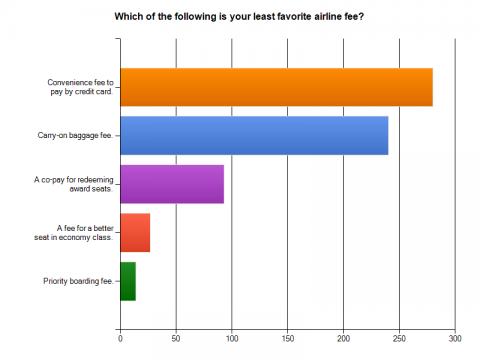
Which of these new fees do you find the most egregious? We ran an online poll this morning (9/8) and here are the responses.

(Photo: l rargerich/Flickr Creative Commons)

  • Anon

    I’m one of those who has the large carry-on purse and the mini-suitcase with wheels when I board. I’m used to receiving looks of exasperation by now, which I think is uncalled for, since my mini-suitcase (designed for flying) fits beautifully into the compartment above my seat, and my purse gets stowed beneath the seat.

    I like to take my things onboard with me because I’ve suffered from having my baggage lost and separated, and while I got it back, I discovered there is nothing more humbling than trying to buy underwear in a city where you don’t speak the language.

    Subsequently, although I’ll likely be in the minority, I’m most upset about the notion that I have to pay $30 for peace of mind.

  • jamru

    One note about the Economy Plus seats on United: Even if it is not a full flight the crew will not let you move into the Economy Plus section without charging you. The last few United flights I’ve been on several folks asked if they could move into unused Plus seats and got the same “only if you pay” response from the crew. No one ponied up for the move and the seats remained empty. It will be interesting to see how this pans out for United.

  • Eric

    @ Anon – You get dirty looks when you bring aboard regulation sized/amount of carry-on luggage? From who, backpackers and duffel bag carriers who insist on shoving their overpacked carry-ons into the overhead bin, so lumpy and misshapen it spills throughout the bin that the only other item that can be stowed up there is probably a camera bag? Ignore the exasperated looks, and next time the FA suggests perhaps you need to check your rolling bag because there’s no room up above, proclaim loudly that there would be if that parka weren’t taking up so much room.

    And to Spirit CEO Baldanza, many people DON’T clean up after themselves anyway. I don’t think paying a fee for your carry-on has anything to do with cleaning up after yourself. Or maybe this is his way of hinting that if you don’t take all your trash with you off the plane, you’ll get charged another fee???

  • http://practicaltravelgear.com Tim L.

    Only when the savings on the ticket are dramatic enough to make up for the gouging fees will people choose to put up with this over and over—as on RyanAir. Otherwise they’ll switch carriers or, more likely, stop flying unless it is absolutely necessary. Many seem to be making the latter decision, which is bad news for the industry long-term. I try to fly foreign carriers whenever possible for international trips. They still treat you like a customer instead of a number to be annoyed and optimized on a spreadsheet.

  • Eric

    This isn’t really a fee issue, but I was truly stunned when I saw the story about RyanAir wanting to do away with co-pilots. I guess if you fly RyanAir, you better take some flying lessons, because if the pilot has the fish for dinner, you’re toast.

  • Phil

    Regarding your comment about better seats in the front of the aircraft and to avoid paying for them and then moving up after the flight has departed. United makes an announcement about passengers not moving up who have not paid for the extra leg room. Yet I have seen people still move up. A simple solution, FA’s could check boarding passes of those sitting in the priority seating area, not just once but perhaps a couple of times during the flight. If someone is caught in the priority seating area, then they can be met a the gate upon arrival and charged the price for the move, it really is stealing from the airline.

  • David Z

    No AOTA – All Of The Above?

  • http://www.imageswritten.biz Susan

    @Tim L

    My husband is a pilot and after my treatment on a recent Continental flight with my kiddos, I am just not flying. It is not fun and not worth it. If we go to Germany next summer, to visit family, I am seriously considering Lufthansa. I will pay more, but I will actually have a snowballs chance of being treated well.

  • J C

    On the moving up to Economy Plus issue. This is a seperate section of the plan, just as business and first class. If you don’t pay for this you have no right to be there. Moving to a preferred location seat in coach is different. Phil is right, to sneak up there is stealing. You pay for a “Section” and thats where you sit.

  • J C

    Correction! I ment “plane” not plan – My bad

  • Michelle B.

    Chris, great article! Since there were so many “others” in the Who charges it list, would it be possible for you to create a grid that shows the Charge in the columns, the airline in the rows and an “X” if that airline has that charge? And keep it as a “sticky” somewhere on this page? I think many travelers would find that useful.
    Thanks!

  • Brian C

    I just booked a flight on EasyJet (UK Based airline) and I think they’re the KING of add on fees. They lure you onto the flight with cheap fairs 23 euros each way from London to Rome.

    From there everything is extra. Checked Backage? 20 Euros. Second Bag? 50 Euros. Priority Boarding? 15 Euros. Pay by Credit Card? 15 Euros.

    They also try and sell insurance and upsell on just about everything.

    In the end the price still came out cheaper than most of their competitors so I’m fine but there’s nothing worse thant getting to that last booking process and realizing there’s one last fee for paying by credit card. That pisses me off every time.

  • Carver

    Charging for premium seats is the most reasonable of charges. That way, the person who most values the seat is most likely to get it (Elites aside)

    For example, on a regional jet, with an A-BC configuration, I want the exit row A seat. I’ll happily pay more for it. The longer the flight, the more I’ll pay.

    Its no different than paying more for first class.

    @Eric

    You misunderstand the CEO’s point. Just as Americans were used to a certain level of retaurant service, i.e. fully bussed tables, McDonalds popularized self-bussed tables and everyone is fine with that.

  • TTNtraveler

    Chris,

    IIRC, Delta did away with their convenience fee for cashing in mileage award seating, even close up fairly recently for North American clients. (Foreign origination can still cost you an arm and a leg.) Finding award availabilty however….

  • NIgma

    On my last flight on Southwest, 4 passengers who paid for early boarding were saving seats for people who didn’t pay the $10. One man was trying to save a “block” of seats. SWA didn’t make them pay the extra fee.

  • Lisa S

    @ NIgma, I didn’t think you could “save” seats for people on Southwest. I suspect you wouldn’t have to honor his request unless you wanted to do so. Please correct me if I am mistaken.

    I used to fly American Airlines (AA) almost exclusively (sometimes it wasn’t available) because I wanted the miles and did enough flying that the higher cost was worth it to me. No more. AA’s fees cost them my loyalty. I fly Southwest whenever it makes sense in the US and prefer to fly international carriers overseas rather than US-based carriers because of the better customer service. I might not accrue miles on these airlines (or at least not enough to redeem for a flight), but the experience is more pleasant. However, unless airlines stop making money (i.e., lose sufficient numbers of passengers), I don’t see these fees disappearing.

  • Salami

    The problem airlines are having is that their cost per seat is WAY too low. So they’re looking for creative ways to compensate for that low price. I say we roll all fees/taxes back into the price, then they charge for additional ‘perks’ like preferred boarding or seating, any checked bag over one, etc. By forcing us to add them all up in order to decide which airline to fly they’re just mistreating those who won’t/can’t figure it out.

    AND, airlines need to cut back on how they entice people into FF programs and limit earning opportunities. It used to be that you would fly an airline based on convenience and service, not by which one is easier to earn FF miles. FF programs are a huge expense to the airlines and they need to treat them as such, by cutting back!

    A complete overhaul of airlines is needed, at least of the legacy carriers. But all these fees show that even newer discount carriers are in trouble with the current fee models…

  • Arizona Road Warrior

    @ jamru – “One note about the Economy Plus seats on United: Even if it is not a full flight the crew will not let you move into the Economy Plus section without charging you.”
    - – - – — – - – - –
    That is very fair. E+ seats are for the UA elites and paying passengers. It will be unfair for the passengers that actually paid for an E+ seat for someone that didn’t paid to sit there.

    This summer, I was flying back from DEN and the FAs did a very good preventing a few non-paying E+ passengers during the boarding process and during the flight who wanted to sit in the E+ section.

  • Arizona Road Warrior

    @ Salami – “The problem airlines are having is that their cost per seat is WAY too low.”
    - – - — – -
    As I have written previously, fares are lower today than 10, 15 or 20 years ago. I think that airlines have reacted to the market in regards to pricing…they want to have low prices.

    @ Salami – “FF programs are a huge expense to the airlines and they need to treat them as such, by cutting back!”
    - – - – - -
    The FF programs are money makers for the airlines.

    @ Salami – “A complete overhaul of airlines is needed, at least of the legacy carriers.”
    - – - – - – -
    There needs to be a level playing field for all of the airlines. You can’t have the discounters cherry-picking the most heavily traveled routes to fly in order to maximize their profits and minimize their costs while expecting the legacy airlines to provide service to small markets as well as to compete with the discounters on price on the popular flights. The reality is that revenues on the popular flights used to subsidizes the flights to the small markets before the discounters came along. The passengers in these small and medium markets will be up in arms if the legacy airlines raised fares to cover the actual cost of these flights, reduced services and/or eliminated services.

  • Arizona Road Warrior

    @ Tim L. – “I try to fly foreign carriers whenever possible for international trips. They still treat you like a customer instead of a number to be annoyed and optimized on a spreadsheet.”
    - – - – - – - – -
    I agree. It is my preference to fly an Asian-based airline or a European-based airline for international trips. While some of the US-based airlines have made recent improvements in their products and services for their international flights, the Asian-based airlines and European-based airlines have better products and services for their international flights. Ten years ago, the Asia-based airlines and European-based airlines started to install flat bed seats and lie-flat seats in First Class and Business Class. The US-based airlines just started to install flat bed seats and lie-flat seats in their planes a few years ago. US Airways just started to install flat bed seats on their planes this year and they have currently two planes converted.

    IMHO, I think that the service is better on non-US based airlines because their FAs are not career employees. Unless a FA speaks a foreign language, it will take at least 20 years for a US-based FA to work their way up to work on the international flights. After 20 years of putting up with all of that crap (i.e. mergers, losing benefits, etc.) on the job, it is hard not to be burn-out, jaded, etc. and this is reflected in how they work with the passengers.

    Being a FA is not a career at the Asian-based airlines…at best, it is a 10-year stop before moving on to something else. There are age restrictions (i.e. a FA ‘retires’ at age 30). I have a business associate whose girlfriend is a FA for a European-based airline…she signs a contract for two years then she must sit out for 3 or 6 months before applying for another position. An airline in the US can’t do these things because it is against federal laws and/or labor unions.

    We have flown with our 4-YO son on Asiana (OZ) and Cathay Pacific (CX) when he was 17-MO old. Both airlines treated our son like royalty or a rock star…they carried our carry-on luggage (six pieces and a car seat) from the gate to the plane then put carry-on luggage in the overhead bins and this was repeated when we deplaned. The FAs on the OZ and CX flights came by every 15 minutes to ask us if we need anything; to hold our son; to play with our son; etc. CX gave a backpack with a Disney DVD and other goodies. OZ gave our son an airplane.

    We have taken over 25 flights (all domestic plus flights to Canada) with our son on US Airways and none of the FAs on these flights help us with our carry-on luggage, our car seat, etc. One time (connecting on a US Airway flight back to PHX after our OZ flight arrived in LAX) my wife asked the FA for assistance since my son fell asleep and she was holding him and couldn’t help me with our carry-on luggage. The FA responded back to my wife that isn’t in her job description to assist us and it is against their union contracts to do so.

  • NAN

    I flew this summer in United Economy Plus for the first time (usually fly Delta but had to go to O’Hare so United was the best option). I decided to pay for the upgrade to Economy Plus because I needed to travel with two checked bags (trade show), which are free with Economy Plus. After doing the math of what I would be charged to check the bags, and what the upgrade would cost me, it turned out to only cost a few dollars more ($19) to get the early boarding and extra legroom in Economy Plus for my Orlando to Chicago flight. That seemed like a good deal for more comfort on a flight of several hours! I’d definitely do it again if it was offered on a flight I was on. I wish Delta had it!

  • Steve

    Regarding the credit card convenience fee: I’m surprised that Visa/Master Card haven’t intervened, as Allegiant is clearly in violation of their merchant agreement. That’s also the most blatantly ridiculous fee, since not only should acceptance of credit cards simply be a cost of doing business in this day and age, but for airline tickets especially it should be assumed that people are going to pay by credit card.

    I’ve ranted about the carry-on fee before, but suffice it to say that the only way I’d consider it remotely reasonable was if Spirit was allowing passengers to check their first bag for free. Regardless, I won’t even consider flying Spirit.

    Regarding fees for better seats: whether or not they’re reasonable depends on what you get for the extra money and how many seats are considered “better.” Charging extra for something like Economy Plus is fine, since there are a limited number of seats with demonstrably better legroom (though even as a tall, relatively skinny guy, the issue isn’t legroom but seat width – I’d pay extra for a few more inches across before I’d pay for a few more inches in front). Charging extra for an aisle or a window seat is ridiculous, IMHO. And what I hate most about the fees for exit-row seats or those in the front of the plane is that it makes it very hard for me to get a seat assignment in advance when I travel for business, since my company won’t pay extra for one of those seats.

    In any case, I think the fact that airlines won’t permit passengers to move to an empty premium seat even in flight when there is zero chance that a paying passenger will occupy it says a lot about what they think of their customers.

    As for early boarding fees, I’d never pay one if I have a reserved seat but I’ve bought early-bird check-in on Southwest. It’s mostly valuable if you don’t want to have to hover over your computer to check in exactly 24 hours before your flight; my experience has been that I can always get an A or a very early B boarding pass if I check in exactly 24 hours in advance. I do think Southwest should consider placing a limit on how many people can check in early, though, since theoretically everyone on the flight could buy early-bird check-in. It’s also very inexpensive at $10 each way, and you don’t really need to buy it for every person in your group. What I do if I travel with my wife is buy early-bird checkin for me and not her; I then grab a window seat in the back half of the plane. Since middle seats are the least desirable, I’ve never had a problem saving a seat next to me.

  • Alan

    United Airlines Mileage Plus Upgrade Co-Pay Fee Investigation

    Wasserman, Comden, Casselman & Esensten, L.L.P. is currently conducting an investigation into United Airlines’ Mileage Plus ticket upgrade policy. As members of United Airlines Mileage Plus program, some consumers are told that they can purchase a regular Economy Class ticket and apply their accrued miles toward a seat upgrade to Business or First Class.

    After opting for the upgrade upon arriving at the airport, some consumers are surprised to find that they must pay an additional “Co-Pay” fee in order to board the Airplane and claim their upgraded seat. These Co-Pay fees can range in amounts to several hundred dollars per seat.

    If you or someone you know has been surprised by United Airlines’ requirement of Co-Pays at the point of check-in, or if you would like more information about our United Airlines investigation, please contact us using the link below:

    http://www.wcclaw.com/CM/ClassActions/ClassActions95.asp

    Please see the Disclaimer Page on our website for important information regarding communications with Wasserman, Comden, Casselman & Esensten, L.L.P.

  • Haustin500

    what is attraction fee

  • Matty

    If you are lucky you can skip the fee for getting a good seat in econ if you ask the gate agent, I personally have had this happen on multiple Air Canada flights, where you usually have to pay 30CAD for those seats.
    I got an emergency row seat on a full flight from YYZ to LHR, just by asking the gate agent. I am 6’4″ so she was very helpful and got everything sorted so that I got that seat instead of who ever was first assigned to it.

  • Matty

    If you are lucky you can skip the fee for getting a good seat in econ if you ask the gate agent, I personally have had this happen on multiple Air Canada flights, where you usually have to pay 30CAD for those seats.
    I got an emergency row seat on a full flight from YYZ to LHR, just by asking the gate agent. I am 6’4″ so she was very helpful and got everything sorted so that I got that seat instead of who ever was first assigned to it.